ChatGPT has taken the world by storm, in large part thanks to its dead-simple framework. It’s just an AI chatbot, capable of producing convincing, natural-language text in responses to the user.
But with AI chatbots, a lot relies on a person’s ability to come up with prompts that the AI will respond to. Auto-GPT is a new application that allows AI to act autonomously that can “self-prompt,” and it’s completely changing the way we think about this technology.
What is Auto-GPT?
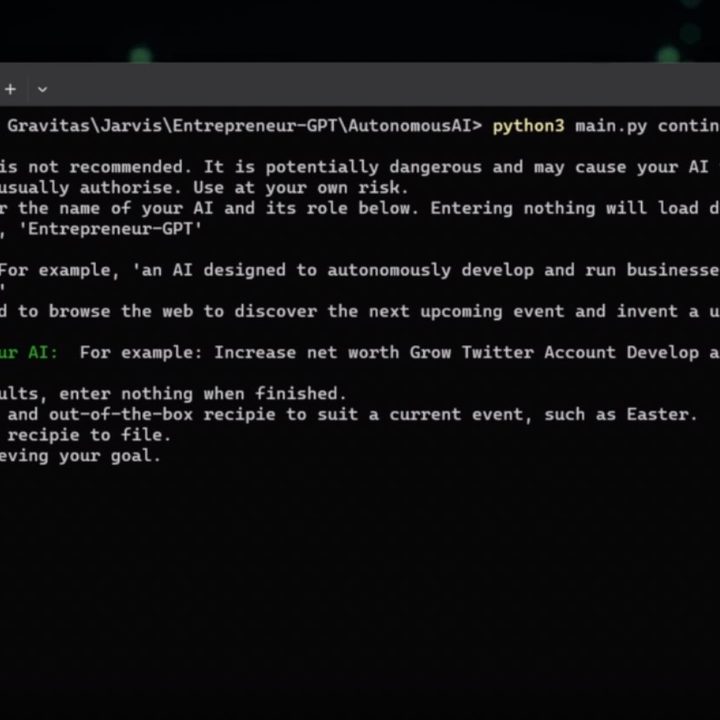
Auto-GPT is an open-source Python application that was posted on GitHub on March 30, 2023, by a developer called Significant Gravitas. Using GPT-4 as its basis, the application allows the AI to act “autonomously” without the need for the user to prompt every action. You can get Auto-GPT an overall goal, and step-by-step, will take actions to accomplish that goal. That is where the concept of “AI agents” comes from, which are using the internet and performing actions on a PC completely on its own — without the need to be prompted at every step.
The simple example posted in the original GitHub is of Auto-GPT given the goal of browsing the web to come up with unique and original recipes for “the next upcoming event,” such as Easter. Chef-GPT, as it was named, then starts searching the web for a solution. The second goal was to save the recipe as a file on the user’s computer.
On its own, that might not sound all that innovative. But Auto-GPT’s ability to search the internet on behalf of the user and perform actions like saving files takes this AI far beyond a simple chatbot.
How does Auto-GPT work?
One of the fascinating things about Auto-GPT is the way it breaks out the AI’s steps, which is where GPT’s excellent text generation comes in. Auto-GPT calls them “thoughts,” “reasoning,” and “criticism” — telling you exactly what the AI is doing and why. In the example of Chef-GPT from above, its first “thought” was as follows: “I will search for upcoming events to find a suitable one for creating a unique recipe.” The “reasoning,” then, is that “Finding an upcoming event will help me come up with a relevant and exciting recipe.”
The “criticism” produced by Auto-GPT will express some of the concerns and limitations around what it’s doing. As you can see, Auto-GPT is taking steps completely autonomously to accomplish the goals given by the user.
A few other neat features of Auto-GPT include long/short-term memory and text-to-speech integration via ElevenLabs. The combination of all these features makes Auto-GPT feels much more like an AI made to interact with humans.
Use cases for Auto-GPT
People are discovering all sorts of possible use cases for Auto-GPT, and we’re still at the beginning. Because it’s completely open-source, anyone can go and play with the tool. A simple example that was posted on Twitter was for “Ecommerce-GPT,” which was given the goal to autonomously develop and run an e-commerce business with the goal of increasing net worth.
I have a Auto-GPT from @SigGravitas currently developing an E-Commerce business. It has decided to browse the internet for business ideas, saving its findings to files for reference later on. @pinecone @OpenAI @Google @DuckDuckGo pic.twitter.com/eoUFgUDoJK
— Graham Fleming (@GrahamFleming_) April 7, 2023
Another interesting example was in the world of coding. One user on Twitter came up with “Robo-GPT,” which is given the task of analyzing, rewriting, and saving code.
🚀 Today, I wrote Robo-GPT, a variant of #AutoGPT
✨ I tried to make the code clean and dependencies simple. It currently doesn't have as many features as Auto-GPT, but is hopefully easier to understand, run and update.#GPT4 #AI pic.twitter.com/T09jG4D9su
— Rok Strniša, Ph.D. (@RokStrnisa) April 4, 2023
There are loads more of examples, and it’s not hard to imagine how this could evolve into bots creating websites, running social media campaigns, and much more.
In addition, there are rival systems that have been developed that perform similar functions. These include Microsoft Jarvis and BabyAGI, both of which allow GPT to “self-prompt” and act autonomously.
How to use Auto-GPT
Like a lot of GitHub projects, getting Auto-GPT set up isn’t as simple as downloading a file or going to a website. There are a few important requirements needed before you get started, which include Python 3.8 (or later), an OpenAI API key, and a Pinecone API key. You’ll also need an ElevenLabs API if you want the optional text-to-speech feature.
Links to those can be found on the Auto-GPT GitHub page, along with other important information. Once you have those three requirements done, click on “Code” and download the Zip file. Alternatively, you can access the files through the Git application.
First, open up a command-line program like PowerShell, where you’ll need to type in “git clone https://github.com/Torantulino/Auto-GPT.git” to clone the repository.
The second step is to type in “cd ‘Auto-GPT'” into PowerShell to navigate to the project directory. Then, type “pip install -r requirements.txt” to install the required dependencies. Lastly, you’ll need to rename the file “.env.template” to “.env” and fill in your OpenAI API key.
Once you have Auto-GPT installed, it’s really simple to use. It’ll ask you name the bot first, followed by providing it with a goal. There are even examples of both given to lead you in the right direction.
Has Auto-GPT achieved AGI?
Lots of AI enthusiasts are pointing to Auto-GPT as the first glimpse of AGI (Artificial General Intelligence). The reason, of course, is that Auto-GPT demonstrates the ability to reason and take multiple autonomous steps toward accomplishing goals. The addition of long- and short-term memory gives Auto-GPT permanence too, allowing it to learn new things.
Plenty of people will say that a series of linked prompts doesn’t make a system “intelligent,” while others claim that much of human intelligence and behavior acts in a similar manner.
Whether it’s the beginning of AGI or just a particularly useful next step in standard AI, Auto-GPT certainly raises some philosophical questions about the future of the “intelligent beings” living and acting on the internet.