The AMD RX 9070 XT has been hailed as the best graphics card to launch in 2025 — although that’s a low bar to meet. Still, it’s great to have a powerful, somewhat-affordable new card, especially since AMD’s last-generation RX 7000-series GPUs are getting a little long in the tooth. But how does the newly-iconic 9070 XT compare against one of the best last-generation cards (and one of the only still available), the RX 7800 XT?
Here’s how they match up.
Pricing and availability
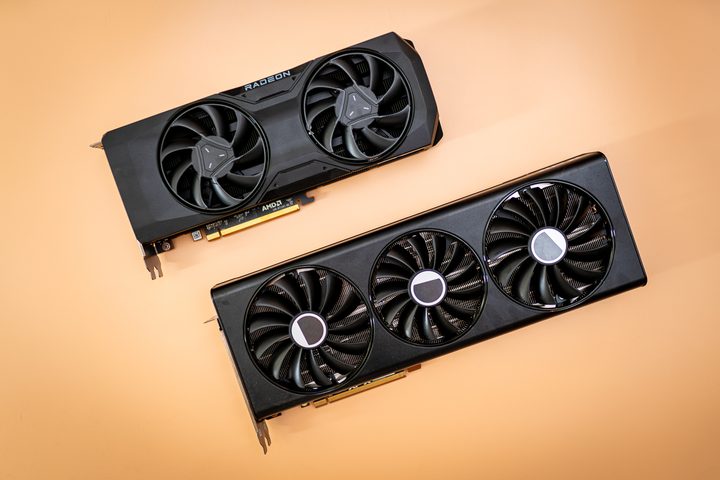
The RX 7800 XT launched in September 2023, with a recommend price of $500. It’s sat around that ever since, with some mild fluctuation. It’s one of the few cards to survive the recent price boom in GPUs, too, and you can still find a few 7800 XTs around for between $500 and $600. That’s not amazing value in 2025 when there are newer, faster cards out there, but with stock and pricing problems across the board, it’s arguably not bad.
The 9070 XT launched at the start of March 2025 with a price tag of $600, but it quickly went out of stock, just like everything else launched this year. Unfortunately, that means that the price is all over the place at the time of writing, with the XT model going for anywhere between $700 when it’s in stock, to over $1,000 when paying the scalper’s price.
Specifications
| AMD RX 9070 XT | AMD RX 7800 XT | |
| Transisitors | 53.9 billion | 28.1 billion |
| Die size | 357mm squared | 346mm squared |
| Compute units | 64 | 60 |
| Ray accelerators | 64 | 60 |
| AI accelerators | 128 | 60 |
| Shader units | 4096 | 3840 |
| Game clock | 2400 MHz | 2124 MHz |
| Boost clock | 2970 MHz | 2430 MHz |
| Memory | 16GB GDDR6 | 16GB GDDR6 |
| Memory speed | 20 Gbps | 20 Gbps |
| Memory bus | 256-bit | 256-bit |
| Total board power | 304W | 263W |
The specifications of these two cards are intriguing, because on the surface they don’t look that dissimilar. There have similar numbers of shader units and compute units, similarly sized dies, the same memory and memory bus. But it’s when you dig into the details that the differences really stand out.
AMD has managed to pack close to double the transistors into the same size die. That’s doubly impressive since AMD isn’t using a smaller process node this generation. All those transistors allow AMD to double its number of AI accelerators and boost the capabilities of its RT accelerators. It’s also given a lot more power to the core, allowing for much faster boost clocks.
That has resulted in an increase in board power, but only about 17%.
Performance
We haven’t had a chance to test the 9070 XT ourselves yet, but taking a look at the benchmark results of these cards in various reviews and tests makes it clear that the 9070 XT is much faster than the 7800 XT. Indeed, AMD’s own graphs suggested it could be as much as 66% faster than the 7900 GRE (though more like 42% on average), which is a card that’s already 10% faster than the 7800 XT.
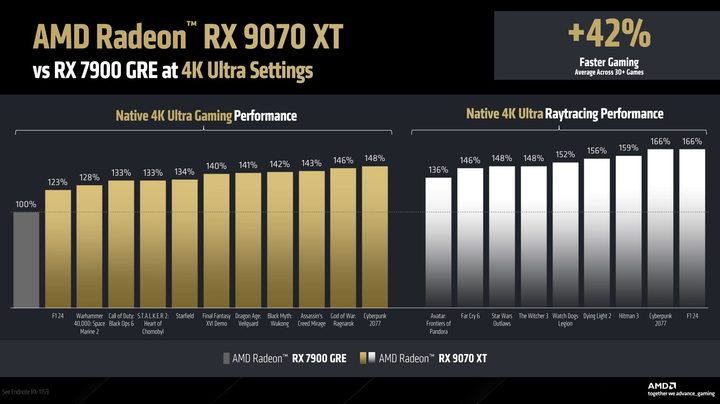
If we consider a wider spread of games, though, with more of an emphasis on general rasterization rather than raytracing, and don’t factor FSR4 frame generation, the 9070 XT is roughly 35% faster than the 7800 XT, which is a very respectable generational upgrade.
However, it can go much further. With overclocking, we’ve seen the 9070 XT eclipse even the RTX 5080, which is over 65% faster than the 7800 XT, and much, much more expensive than even the 9070 XT’s inflated price tag.
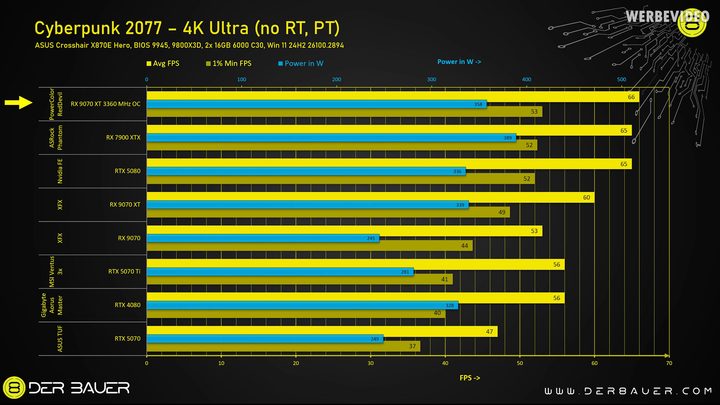
That is dependent on the model of 9070 XT you use, your own system cooling, and your ability to overclock in the first place, but the potential is certainly there for this card to be far faster than it is at stock. While you can overclock the 7800 XT too, it doesn’t have the same headroom as the new card and won’t deliver the same kind of uplift, even in ideal scenarios.
The additional upscaling capabilities of the 9070 XT shouldn’t be discounted, either. The additional AI accelerators and new-generation design makes them much more capable than the 7800 XT in boosting frame rates with FSR and frame generation in compatible games makes a huge difference. The list of supporting games isn’t long at the moment, but it’s growing all the time.
The 9070 XT is much better, if you can get it
Buying graphics cards in 2025 is not easy. Prices are crazy, stocks are low, and the FOMO is real. But if you can wait out these turbulent times, there’s no question that the 9070 XT is the better card here. It’s much faster, overclocks like mad, has impressive ray tracing performance, and its new upscaling and frame generation capabilities are awesome. Nothing that AMD has ever made before can match it in the right setting.
But don’t discount the 7800 XT just yet. Indeed, if you have one, don’t rush to upgrade it unless you have a very real reason to. It’s still a strong card, and until prices come down, it still offers strong value for money. I wouldn’t necessarily buy one new, but then if you have around $600 to spend, there’s nothing out there that offers that kind of value right now. Prices should come down in the future, but if you need a new card right now, the 7800 XT is still a decent buy.