DDR5 memory is the current generation of system RAM, with greater bandwidth, increased capacity, and lower power demands than the previous DDR4. It helps to make the most of not only modern CPUs but onboard graphics, too. If you want to take advantage of the fastest memory kits around, here’s everything you need to know about DDR5.
Pricing and availability
Typically, new-generation memory starts more expensive than the last, especially at higher capacities or frequencies, and then slowly prices equalize before the new, more populace generation of memory becomes the more affordable option.
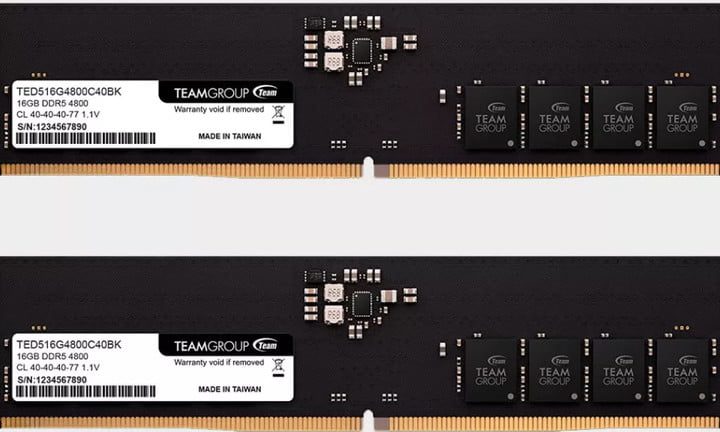
To illustrate that, the first DDR5 RAM chips were made in 2018, though it wasn’t until 2020 that the standard was officially released, and actual commercial kits didn’t become widely available until the summer of 2021. TeamGroup released the first kit of twin 16GB sticks at DDR5-4800 speeds, with a price tag of $311. That was more expensive than most 32GB DDR4 kits, but prices dropped as DDR5 became more widely adopted.
The first platform that supported DDR5 was the first generation of Intel’s Alder Lake CPUs, which first arrived in 2021. As DDR6 is on the horizon, you’ll find DDR5 installed in most new laptops and desktop computers.
Performance
DDR5 memory naturally offers a number of performance improvements (such as a greater frequency potential) over DDR4. The first kits featured slightly greater bandwidth than that of the best last-generation kits, with official motherboard support at those higher frequencies.
Although DDR4 kits were shown to be capable of running in excess of 5Gbps, the official specification’s limit was 3.2Gbps. In comparison, DDR5 debuted at 4.8Gbps, but can reach up to 6.4Gbps. Memory manufacturers will likely push the data rate far beyond that in due course, potentially reaching 8Gbps or above.
As is expected from higher bandwidth memory, timings for DDR5 were looser than typically used for its predecessor. The first TeamGroup Elite DDR5 modules had timings as loose as 40-40-40-77. In comparison, a competitive DDR4 G.Skill TridentZ DDR4-4800 kit has timings of just 20-30-30-50. That advantage gave DDR4 a slight performance edge in some settings compared to early DDR5 memory modules, but performance has improved considerably as the technology developed.
The channel architecture of DDR5 also plays a part in improving its performance, by enhancing memory access efficiency. With DDR5, each DIMM has two channels rather than one. Although the overall width of these channels remains the same — 64 bits — the use of two smaller channels improves efficiency, and in turn improve performance, as well as signal integrity.
In one early benchmark, a 32GB DDR5 kit was over a third faster than a comparably specced DDR4 kit (with much tighter timings) in most tests and up to 112% faster in one particular benchmark.
Capacity and power
One of the most obvious and immediate advantages of DDR5 is its support for greater-capacity memory chips. Where DDR4 dies were capped at 16GB, DDR5 has the ability to reach 64GB per chip, potentially offering individual stick capacities as high as 256GB. For mainstream PCs, this won’t hold a huge advantage at the top end, but it will be a big boost for HEDT systems and enterprise servers, where much larger single CPU memory arrays will be possible, further increasing the amount of data those monstrously powerful multi-core CPUs (and multi-CPU arrays) can access simultaneously.
In the consumer market, the maximum DDR5 size per stick is 128GB.
One area where this benefits mainstream PC owners is the upgradeability of their systems. Running a system on a single stick of 16GB or 32GB of memory makes it much easier to upgrade in the future with another stick. That’s particularly useful for small mini-ITX systems, which may only have two DIMM slots.
Low-power systems also benefit from DDR5, as it’s rated to run at just 1.1v. That’s 0.1v less than DDR4, which can run higher when pushed using XMP or manual overclocking. DDR5 offers some performance advantages when running at higher voltages, too, and undervolting enthusiasts have managed to reduce power demands further while still maintaining higher speeds. That could be great news for laptops looking to boost battery life on new-generation hardware.
Ready to upgrade to DDR5? Check our RAM buying guide if your motherboard supports both DDR4 and DDR5. Otherwise, it’s time to look for the best motherboard for a full system upgrade.