
Text-to-speech has drifted out of accessibility menus in the past few years and now stands in the spotlight as a central component of the modern software stack. The voice-first applications category is growing every day, and those specialized digital assets contribute to the text-to-speech movement. The technology also powers audiobooks, meeting assistants, and customer service agents. With increased demand, model developers have felt more pressure to create voices with a convincingly human sound, without latency spikes or per-character pricing that make production deployments untenable.
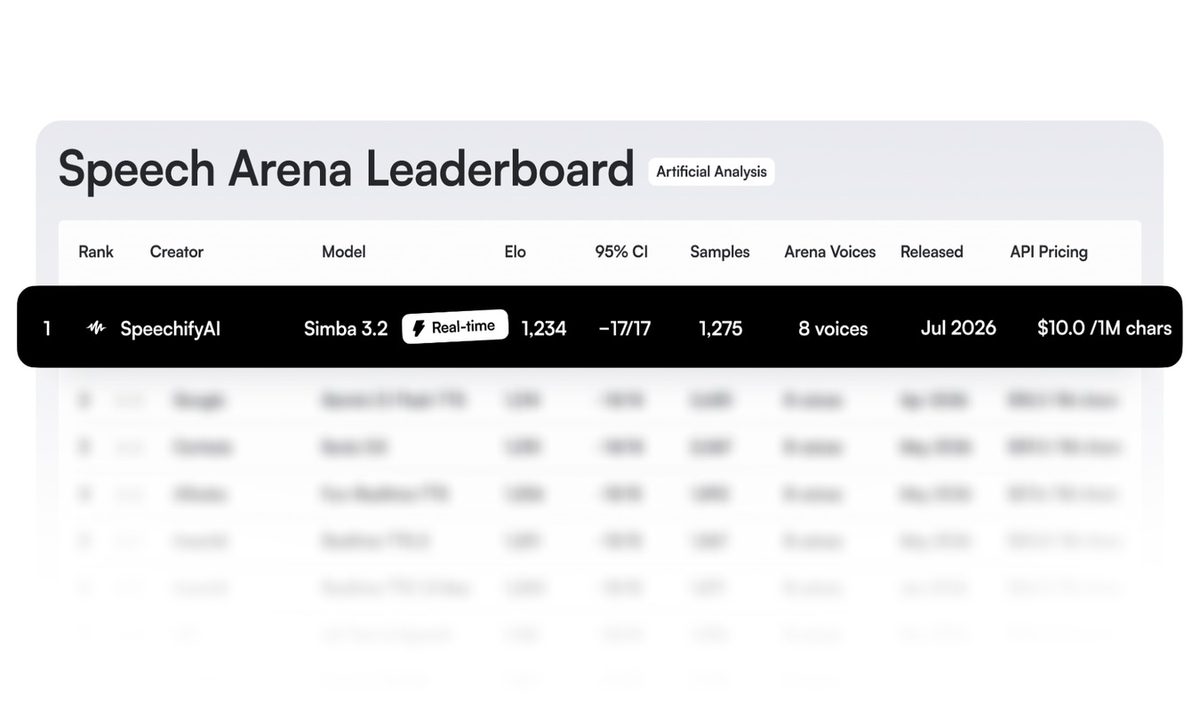
Removing hurdles helps developers and businesses see the value in bringing voice to their products, so they do not necessarily have to choose between quality, speed, and cost. In the broader discussion on the evolving text-to-speech market, this type of product may create opportunity for improved cost, quality, and latency, a passageway to added business and consumer applications. SpeechifyAI’s Simba 3.2 is among the models competing on these measures, currently ranking at the top of the Artificial Analysis text-to-speech leaderboard.
Common Trade-Offs in Voice AI
Three problems have cropped up historically for developers tasked with evaluating a text-to-speech provider. A significant trade-off exists among the three prevalent models available in the text-to-speech world. The most natural-sounding models are typically the most expensive, with pricing that makes high-volume products, such as long-form content, real-time agents, or global consumer apps, financially difficult. The faster, cheaper options sometimes compromise on the quality, so voices have a more robotic feel and tend to fall short on emotion and pacing. Models tuned for low latency, the streaming-first variety, have their faults too: they often lag behind on fidelity benchmarks expected by studios and enterprises.
The resulting market creates an environment where teams use multiple providers for different uses, or accept that a ceiling exists for what the product can do with voice. These limitations have become a frustrating constraint, as voice agents move into production at scale.
A Shift Toward All-in-One Performance
Improvements in model architecture and training efficiency are helping some providers reduce these trade-offs. As a company dedicated to voice AI research, SpeechifyAI has worked for the past several years to remove the hurdles to building with speech through Simba 3.2. The model reached first place on Artificial Analysis’s independent text-to-speech leaderboard, which compares commercially available models using standardized evaluations.
Speechify Founder and CEO Cliff Weitzman framed the launch around that combination. “Simba 3.2 is our best model yet, now available on Speechify.ai,” he said in an announcement. “It’s built to power voice agents at scale and perfected from millions of A/B tests we run in our consumer platform. In TTS APIs, three things matter: cost, quality, and latency. Simba 3.2 has achieved SOTA on this trifecta, topping the Artificial Analysis TTS leaderboard at $6/1M chars on our scaled plan.” The model is being put to good use. It now also powers SpeechifyAI Agents, the company’s new voice-agent platform for businesses, available with its developer tools at speechify.ai.
Empowerment Through Voice
The ideal for creatives is that anyone building the next generation of software can access expressive and reliable voice models. These tools should not be limited to teams with the largest infrastructure budgets. Although access is expanding, the market is still at an early stage. Voice features are becoming a more common component of digital communication alongside text and images. Models such as Simba 3.2 continue to equalize the playing field, so that trade-offs no longer define
the category. This has opened a world of possibilities for the youngest generation of developers, creators, and businesses so they can build products that create a vastly different digital world.
Prices and availability are accurate as of the time of publication and are subject to change without notice. Please check the retailer’s website for the most up-to-date pricing information.


